Olive Sourdough Loaf

Okay, my goodness …. you have to try this loaf.  Love kalamata olives any day of the week, but add them to a loaf of sourdough goodness, include some fresh garlic chunks and oregano right out of the garden and you have a sure fire winner.

olive loaf 6

I think it is the combination of sourdough starter with the yeast that creates the perfect crumb and texture for soft and delicious bread.

  • 1 cup (227g) sourdough starter, ripe (fed) or discard
  • 1 1/4 cups (283g) lukewarm water
  • 1/4 cup (50g) olive oil
  • 2 teaspoons instant yeast
  • 1 tablespoon sugar
  • 2 1/2 teaspoons salt
  • 2 cloves garlic, finely chopped
  • 1 tablespoon fresh oregano, finely chopped; or 1 1/2 teaspoons dried oregano
  • 4 1/2 to 4 3/4 cups (539g to 574g) Unbleached All-Purpose Flour
  • 1/2 to 3/4 cup (71g to 142g) drained, pitted, and coarsely chopped kalamata olives
  1. Combine all of the ingredients, except the olives, mixing and kneading to form a smooth dough then fold in the olives.
  2. Cover the dough, and allow it to rise until it’s doubled in size, about 90 minutes.
  3. Gently divide the dough in half; it’ll deflate somewhat.
  4. Shape each piece of dough into a round loaf. Place each loaf on a lightly greased or parchment-lined baking sheet.
olive loaf 3

Knead the olives in until the dough is soft, only slightly sticky to the touch, and smooth.

Olive loaf 1

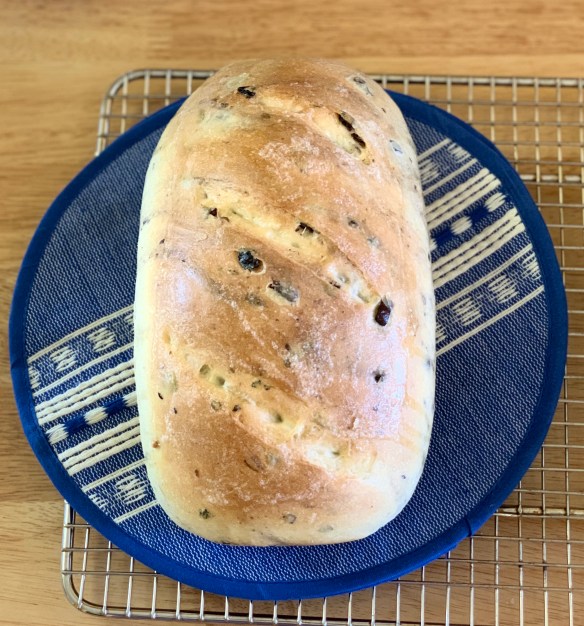
This loaf came out of the oven looking irresistible.  It was amazing!


olive loaf 4

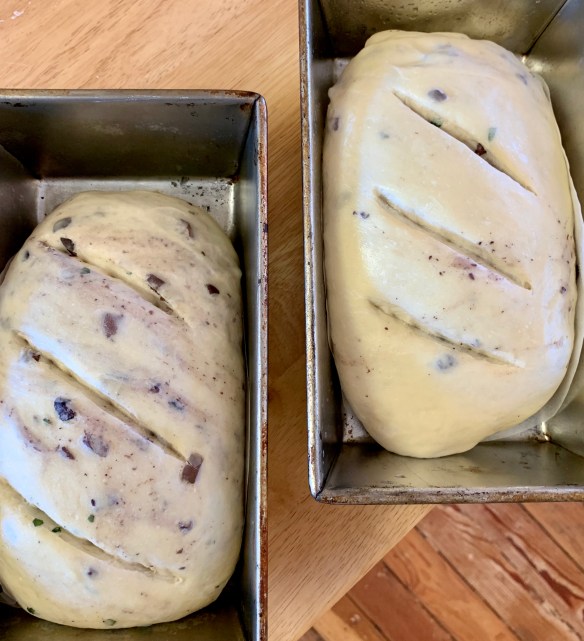
I was looking for a loaf shape today, so baked them in these pans.

olive loaf 5

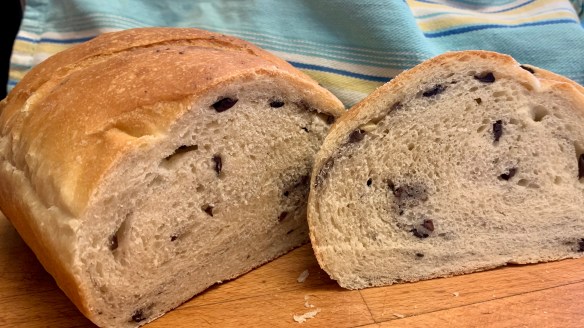
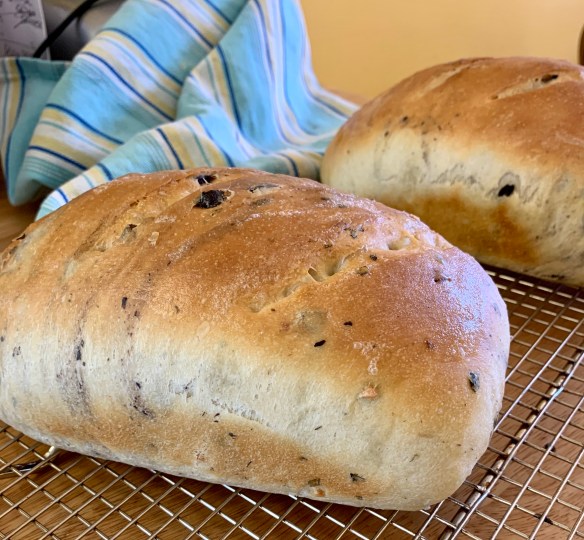
Just look!  These olive loaves were absolutely perfect – the texture and flavour can’t be beat.

This recipe came from the King Arthur Flour website, and if you ever have any questions about baking, check out their website, they have everything.


Sourdough Crackers

These crispy, crunchy, tasty crisps are the perfect way to quickly use up some of that sourdough starter discard that is threatening to take over your fridge.  Eaten on their own, or as a vessel for your favourite dip, they are a winner any way you serve them.

Sourdough crackers 8

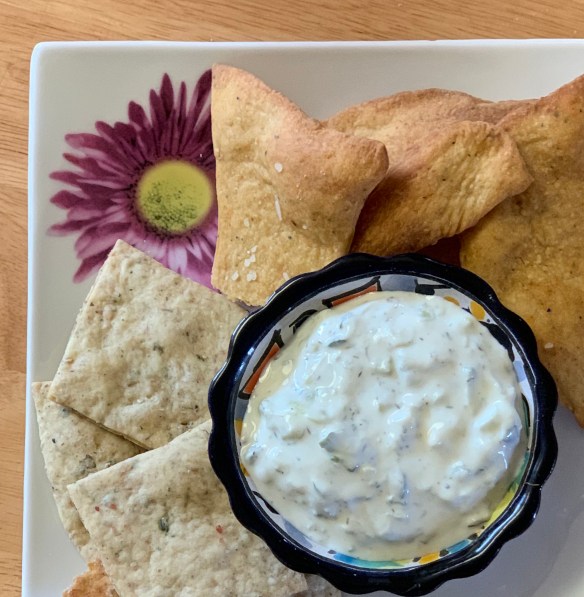
A little fresh homemade tzatziki sauce was the perfect way to eat up a bunch of these crisps!

  • 200 grams (about 1 cup) mature sourdough starter
  • 60 grams (about 1/2 cup) all purpose flour
  • 60 grams (about 1/2 cup) whole wheat flour
  • 12 grams (about 2 tbsp) rye flour
  • 32 grams (3 tbsp) extra virgin olive oil
  • 1 tbsp dried herbs de Provence (or any herbs you like)
  • 1/2 tsp fine sea salt


  • flaky sea salt for topping

In mixing bowl combine all ingredients except for the flaky sea salt.  Mix well, kneading until you get it all together in a nice smooth ball.

To get 200 grams of starter, I often use what I have left from the jar I am feeding, then add to it with starter discard that is in the fridge.  If using entirely discard from the fridge you can either wake it up with a feed and use it once you see it has doubled, or just use it straight from the fridge.  With these crackers you are mainly looking for the flavour more than a rise like you expect from a loaf of bread.

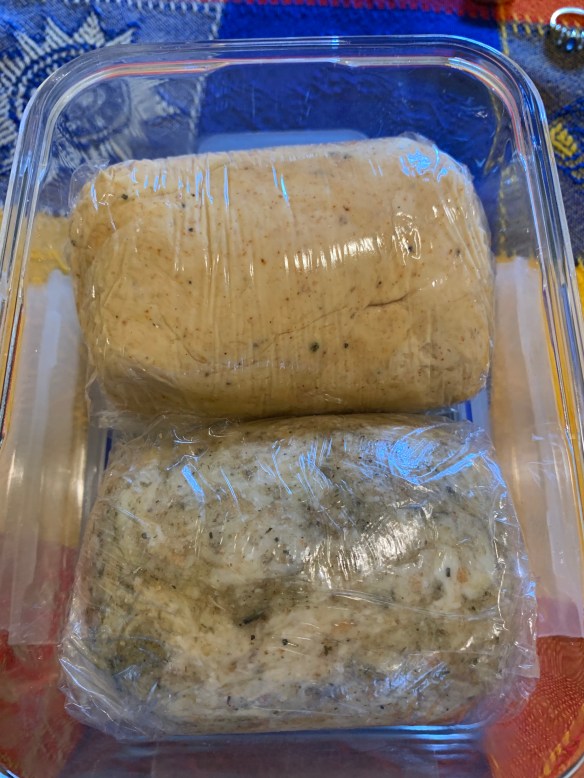
Wrap tightly in plastic and put in the fridge for anywhere from 30 minutes to 24 hours.  Sitting helps the sourdough flavours to develop, as well as make the dough easier to work with.

Preheat oven to 350 and line 2 baking sheets with parchment.

Cut dough in half, place one half in fridge and roll out the other very thin, as thin as you can get and still work with it.  If you like a hardier crisp, then just roll out to 1/4 inch.  I’ve also used my pasta rolling machine with varied success.  When the dough feels soft and supple it works extremely well, but if your dough ends up a bit on the drier side of things it is easiest to roll out by hand)

You can either cut the dough before putting on the baking  sheet, or bake them as is and then break them into rustic crisps.

Spritz very lightly with water, then sprinkle with flaky sea salt right before baking.

Bake for 12-15 minutes – make sure you rotate your pans half way through for even baking.

Sourdough crackers 4

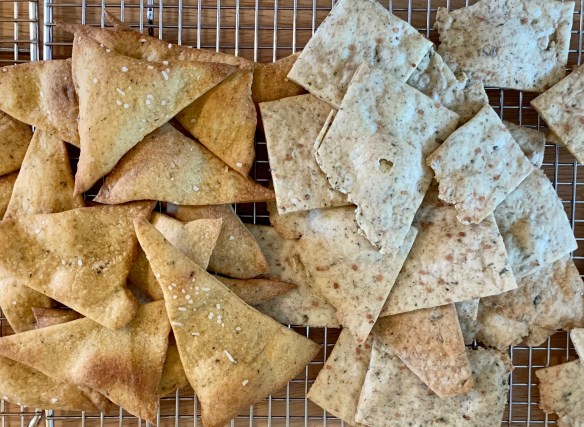
This dough is with the exact measurements and seasonings listed above.  It made a drier dough, and was much easier to roll out by hand than it was to put through the pasta roller.

Sourdough crackers 3

This dough was made with less whole wheat and rye flour, and it was by far the easiest dough to work with and slid through the pasta rollers with ease..  For seasoning I used my granddaughter Sloan’s magic taco seasoning mix.  They were delicious!

These crackers are only limited by your imagination!  Use any variety of flours or seasonings and get creative.

Sourdough crackers 1

These literally took minutes to make, and they are ready for the fridge.  I rested the dough until the next day (just because that was easiest today), and then rolled them out the next day.

Sourdough crackers

I cut these ones into long triangles prior to baking, but it is just as easy to create a more rustic crisp by baking them first and then breaking them up.

Sourdough crackers 2

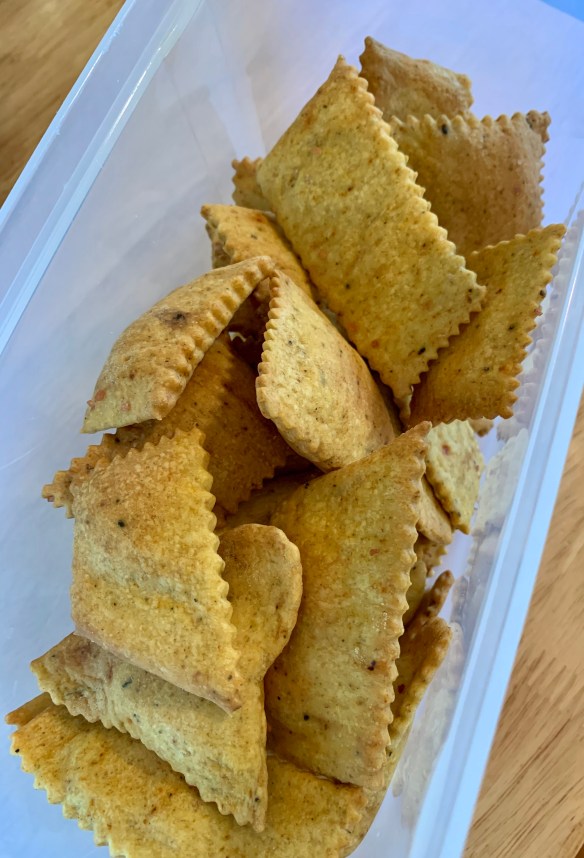
These herby little bites were cut into a square (fish) shape prior to baking.

Sourdough crackers 5

Aren’t they pretty??  I loved these!  So easy to make, and the extra bonus is that so far I haven’t actually had to “discard” any of my discard.

I found this recipe during one of my many ventures down the internet rabbit hole in search of ways to use sourdough discard – it was on http://www.loveandoliveoil.com

img_3328

Pretty hard to go back to buying crackers when you realize how easy these are, and how absolutely delicious.


Easy, authentic Sourdough Bread

It’s the 2020 Covid-19 pandemic, and like everybody else on Instagram, I’ve slipped down the rabbit hole of sourdough.  From initially thinking this is far too much work, don’t like being a slave to a starter, and ending up being a sourdough convert is very much a slippery slope folks, so don’t start unless you are prepared!  I’ve tried a variety of methods, and ended up with a variety of breads, all delicious, but this one … it’s going to be my house bread.   Chewy, dense, yet somehow light … it’s the perfect sourdough loaf.

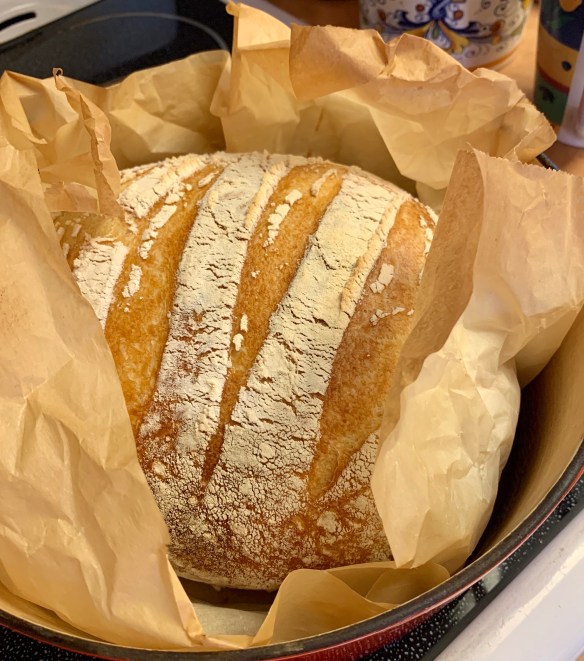
Sourdough best

This loaf just made me happy, and when Sloan said she loved it, I was content.

  • 50 grams or bubbly sourdough starter, 1/4 cup
  • 350 gramswarm water (80° F)(1 ⅓ cups plus 2 tablespoons)
  • 500 grams bread flour (4 cups plus 2 tablespoons) You can use other flours, too: white unbleached flour, white whole wheat, or spelt. Whole wheat flour will be denser and won’t rise as much as white flour. For your first few loaves, you’ll have more success if you don’t use it. Don’t use gluten-free flours.
  • 9 grams finely ground sea salt ( 1½ teaspoons) or Himalayan salt

You need to make sure your sourdough starter is bubbly and ready to go. If it has not been fed recently then take a few spoonfuls of sourdough starter from your fridge and give it that much flour and water and let it ferment for 6 – 8 hours.

NIGHT PRIOR TO BAKING

Before bedtime (the night prior to baking), gather all your ingredients.

Close to your bedtime, add the bubbly sourdough starter and warm water to a ceramic bowl. Mix them together with a whisk until well combined.

Then add the flour and salt and combine together with a stiff spatula. You can also use your hands to get the flour fully incorporated. The dough will look a little scraggly, feel dense, and stick to your fingers. Try and scrape off as much dough from your hands as possible but don’t over mix it at this point. Then cover the bowl with plastic wrap for 30 minutes.

After 30 minutes, flour your hands and work the dough into a smooth ball. Do this by folding the dough over and pressing it into the center until the dough starts to turn into a smoother ball.

BAKING DAY

In the morning, use your spatula and gently pull the dough from the bowl onto a lightly floured work surface. Dust your hands with flour and start at the top and fold the dough over to the center, repeating on all sides (add more flour if needed).
Then flip the dough over and let it rest for 5-10 minutes.


Line an 8-inch bowl with a towel and dust generously with flour. Make sure your hands are still floured and pick up the dough and place it in the bowl with seam side up.

Cover the bowl and let it rest for 30 to 60 minutes. In the meantime, preheat your oven to 450 degrees. Cut a piece of parchment paper to fit your pot, leaving excess so you can grab the bread and take it out of the pot. Place your parchment paper over the bowl and invert the bowl to allow the bread to release onto the paper.

With a small razor blade or serrated knife, score the bread with four slashes.

Pick up the parchment and carefully place your bread in the pot.

Place the lid on the pot and place in the oven for 20 minutes. Then remove the lid and continue baking for 30 more minutes.

You can take it out of the pot and onto the rack to bake for 5 minutes longer to darken the bread if you’d like.

When bread is done, take bread out of pot and place on a wire rack to cool for about 20 minutes to an hour, although we often can’t wait to eat it! Store loaf in a bag on the counter, or this bread freezes beautifully

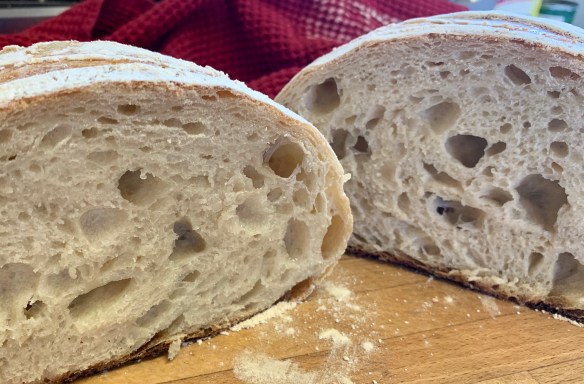
Sourdough best 2

Apparently the overnight rest helps to give the bread some volume, and more flavour, but also helps with the digestive properties – whatever the reason, it works!

Sourdough best 3

This bread was moist, tender and oh so delicious – it will be on repeat around here.

If you would like a little more guidance, lots of clear photos, and many sourdough tips, head on over to the site I got this recipe from – Cultured Food Life.


Sour Cream & Onion Biscuits

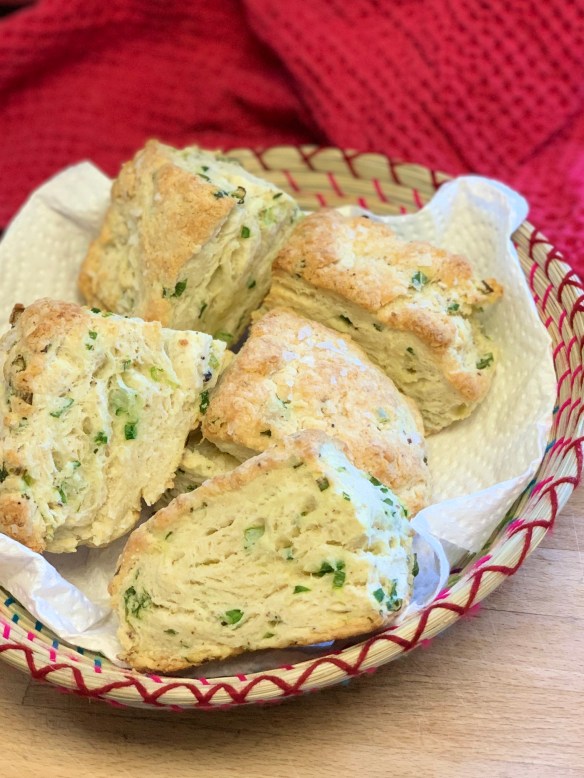
Buttermilk Chive 2

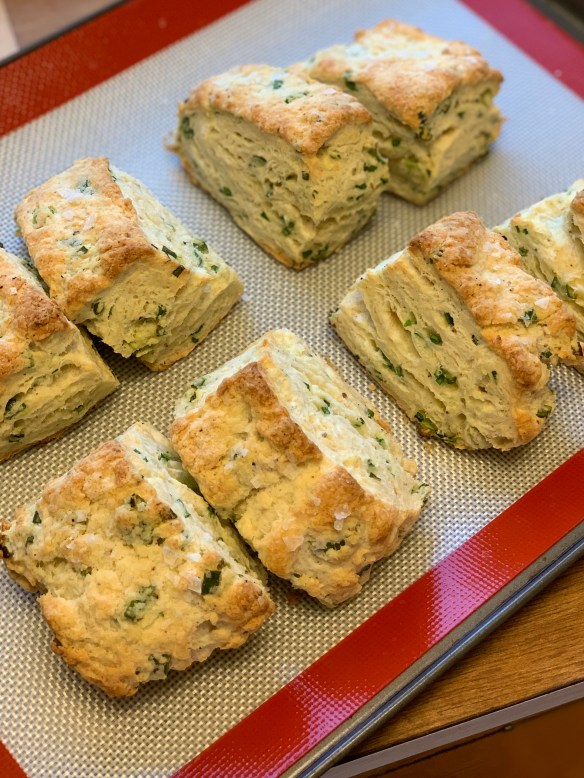
Layers and layers of flaky biscuit with fresh chives …. these are a winner any day of the week.

You know those potato chips of the same flavour??  I don’t like them one little bit.  In the first place, I don’t care for sour cream.  Sure, I use it in recipes, but never as a topping for anything where you just taste sour cream …. yuck.  I know I’m in the minority on that.  These biscuits though?  The sour cream makes them rich and gives them a slight tang that is perfect to offset that richness.  Scallions are my favourite in everything right now …. just desperate for fresh vegetables at this time of year I guess.

  • 8 scallions, sliced thinly
  • 12 Tbsp. chilled unsalted butter, divided
  • 2½ tsp. kosher salt
  • 1 tsp. freshly ground black pepper
  • 1¾ tsp. baking powder
  • ½ tsp. baking soda
  • 1¼ tsp. sugar
  • 2½ cups all-purpose flour, plus more for surface
  • 1¼ cups sour cream, plus more for serving
  • Flaky sea salt

Place a rack in middle of oven; preheat to 425°. Line a baking sheet with parchment paper. Trim root ends from 8 scallions. Thinly slice crosswise (not on a diagonal); set aside.

Melt 2 Tbsp. chilled unsalted butter by whatever method is easiest for you; set aside. Whisk 2½ tsp. kosher salt, 1 tsp. freshly ground black pepper, 1¾ tsp. baking powder, ½ tsp. baking soda, 1¼ tsp. sugar, and 2½ cups (313 g) all-purpose flour in a large bowl to combine.

Cut remaining 10 Tbsp. chilled unsalted butter into ½” pieces. Add to dry ingredients and toss to coat. Using your hands, work butter into dry ingredients, smashing it between your fingers and flattening it between your palm until there are lots of thin shards and pea-size bits. Add reserved scallions and toss to evenly distribute.

Create a well in the center of mixture and add 1¼ cups sour cream to the center. Using a fork and working in circles, mix until large shaggy clumps form. If your bowl is wide enough, fold dough over itself a couple of times inside it until it comes together.

  • Pat dough into an 8×4” rectangle about 1” thick.

  • Working from a short side, fold dough in thirds as you would a letter. It doesn’t need to overlap perfectly. Pat dough into another 8×4” rectangle, then fold dough in thirds like a letter one more time. (You’ll have done the folding procedure two times total.) Pat dough back into an 8×4” rectangle and straighten up with your hands and/or your bench scraper. (This folding method is what will create those nice flaky layers in your final biscuits.)

  • Cut rectangle in half lengthwise, then cut each half crosswise into 4 squares for a total of 8 biscuits.

Transfer biscuits to prepared baking sheet. Brush tops gently with melted butter; sprinkle with flaky sea salt.

Bake biscuits until golden brown, 18-22 minutes.  Serve warm with sour cream or butter.

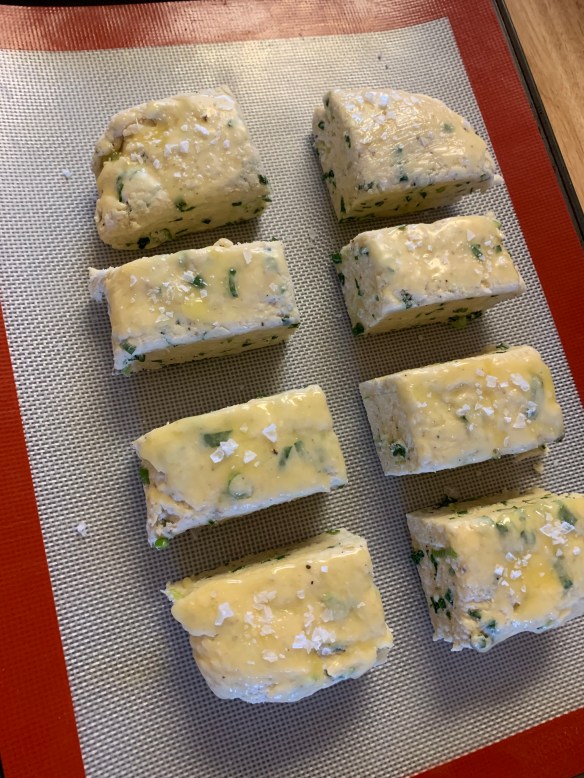
Buttermilk Chive 3

Ready for the oven – already you can tell they are perfect.

Buttermilk Chive 1

Just look at all those flaky layers – it comes from the folding technique.

If you want more concise instructions on how to make these, pop on over to the Bon Appetit website, and check out their “Basically” section.  Molly Baz made these, and not only are her instructions (complete with short videos) simply perfect, these biscuits are divine.

Flakiest Biscuits

Okay, here they are – BACK by popular demand … my fantastic baking powder biscuits.  

Biscuits 1

I’ve tried out a new technique …. folding the dough.  Pat into a rectangular shape and then fold into 3 (like folding a letter into an envelope), pat out into another rectangular shape and repeat.  You can literally see the folded dough, and just look at those flaky layers!  Finish with a little melted butter and sprinkle with salt and freshly cracked pepper before baking.

Once you get this down pat you will rely on these biscuits for anything from a summer morning with fresh peach jam or a winter evening served with a family favourite – chili, soup, stew … every household has their own comfort dinner!

  • 2 cups flour
  • 1 tsp salt
  • 1 tbsp sugar
  • 4 tsp baking powder
  • 1/2 cup cold butter
  • 1 egg
  • almost 1 cup milk or buttermilk

Stir dry ingredients to blend and then with pastry blender, or 2 forks, blend in 1/2 cup cold butter (my tip: freeze the butter for 15 min ahead of time, and use the large holes on a box grater to grate the butter – instant flakes of butter)

Lightly beat 1 egg in a 1 cup measure, then stir in enough milk to reach the 1 cup mark.

With a fork, stir the egg/milk mixture into the dry ingredients – only enough to have it start to hold together.  Turn onto floured surface and … oh so gently … without overmixing … pat it together, and then into a solid shape, about 1 inch or so in height.  Using floured biscuit cutter (or your favorite glass) cut out shapes and place on floured baking sheet.

These are so flexible – if you want to add any herbs, or cheese – do so at the dry ingredient stage.  Go ahead and experiment – makes these your own family favorite!

To guarantee extra tall, fluffy biscuits, pop them into the fridge or freezer for a few minutes.  The combination of hot oven and cold butter creates magic!

Bake at 400 for 15 – 20 minutes (depending on your oven – check it at 15) until lightly golden and very fluffy!  Image

Hot Tomato Feta Salad & Crispy Flatbread

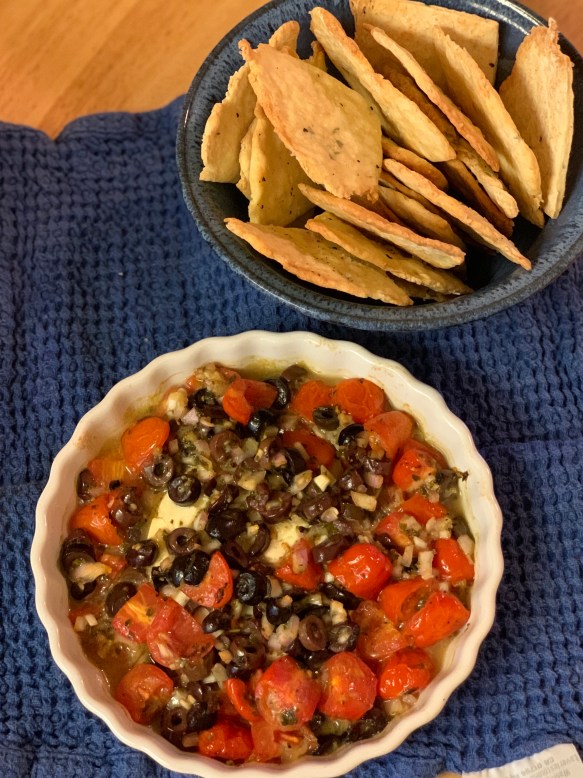
Tomato Feta Salad 2
This could just as easily be an appetizer as a side dish ….tonight it was a side dish for our roasted chicken and it was delicious!  Super quick and easy, along with ingredients I love and that made it a total win.

1 cup cherry tomatoes, halved
1/3 cup chopped, pitted Kalmata olives
1 clove garlic, minced
1/4 cup minced red onion
2 tablespoons finely-chopped fresh flat-leaf parsley, divided
1 teaspoon dried oregano
1 teaspoon olive oil
Freshly ground black pepper
1 8- to 10-ounce block feta
Crackers, flatbread*, pita chips, or crostini, for dipping

In a bowl, mix the tomatoes, olives, onion, garlic, 1 tablespoon of the parsley, oregano, olive oil and a few grinds of pepper.

Feel free to substitute the feta with haloumi, or goat cheese, either would be great.

On a grill: Heat your grill to medium-high. Set the feta block in the middle of a piece of foil. Pile the tomato mixture on top of the feta. Fold up the edges of the foil so that it will hold in any liquid as it cooks. Place the packet straight on a grill for 15 minutes to warm it through. Remove from grill and transfer to plate or serving dish.

In the oven: Heat oven to 400°F. Check to see that your dish is oven-proof. Place the block of feta in the middle of your dish. Pile the tomato mixture on top of the feta. Bake for 15 minutes.

Both methods: The feta will not melt, just warm and soften. Garnish with parsley and serve with crackers; eat immediately. As it cools, the feta will firm up again.
Flatbread 1

I’m guilty of poaching this recipe right off the Smitten Kitchen website, and if you haven’t visited that site, hop on over.  Deb Perelman has fantastic recipes, but even just her writing style is worth a read.
Flatbread 4

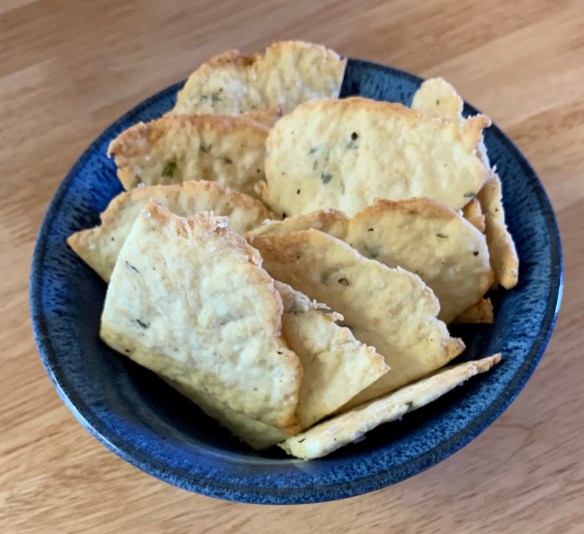
Can’t believe how good these are!  I had to use the herb I had on hand, so these are made with thyme, not rosemary.  Can’t wait to try with fresh rosemary out of my garden.

*Flatbread.  also from http://www.smittenkitchen.com

  • 1 3/4 cups (230 grams) unbleached all-purpose flour
  • 1 tablespoon chopped rosemary plus 2 (6-inch) sprigs (optional)
  • 1 teaspoon baking powder
  • 3/4 teaspoon kosher salt
  • 1/2 cup (120 ml) water
  • 1/3 cup (80 ml) olive oil plus more for brushing
  • Flaky sea salt such as Maldon

Heat oven to 450°F with a heavy baking sheet on rack in middle. Lightly coat a large baking sheet with olive oil.

Stir together flour, chopped rosemary, baking powder, and salt in a large, wide bowl. Make a well in center, then add water and oil and gradually stir into flour with a wooden spoon until a dough forms. Use your hands to gently knead dough inside the bowl 4 or 5 times, until it comes together in a semi-smooth ball.

Divide dough into 3 large or 6 smaller pieces and roll out one piece at a time on an unfloured counter, to about 10-inch (for larger pieces of dough) or 7-inch rounds (smaller pieces) — shape can be rustic; dough should be thin. Lift flatbread onto prepared baking sheet. Repeat with remaining pieces of dough. I can sometimes squeeze 6 small flatbreads on a half-sheet pan; sometimes I need to bake 1 to 2 in a second batch.

Lightly brush tops with additional oil and scatter small clusters of rosemary leaves on top (if using), pressing in slightly. Sprinkle with sea salt. Bake until pale golden and browned in spots, 8 to 10 minutes, rotating flatbreads if needed on the pan for even color. Let cool then break into pieces.

I cut mine into triangles before baking, and they came out perfectly.  Read the full Smitten Kitchen recipe for more ideas, you will be happy you did.

Raspberry Coconut Banana Loaf

Here we are, in the midst of the Covid-19 crisis, I’m working from home, and my stress management is to bake.  Lots.  I planned on making a banana blueberry loaf, but where are the blueberries I was so sure were in my freezer?  Who knows?  Only realized that of course when I was in the midst of the batter, so here we are, and sometimes the best recipes come from necessity!  This is one of those happy circumstances.

banana loaf 2

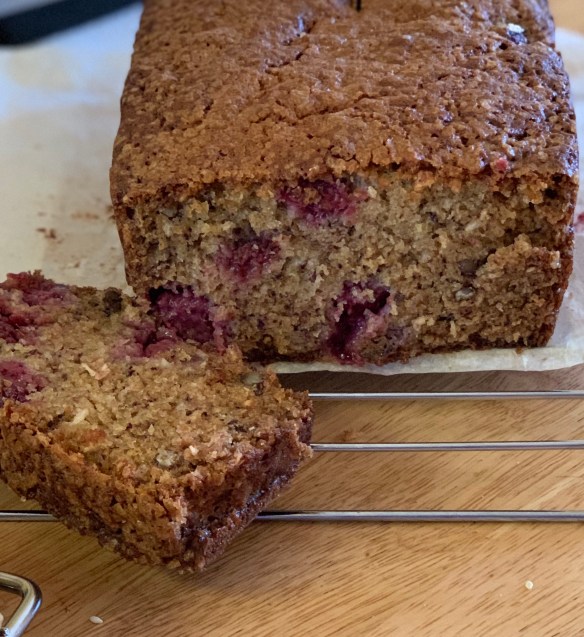
Just look at that crunchy top!

  • 1 1/2 cups all purpose flour
  • 1 tsp baking soda
  • 1 tsp salt
  • 1/2 tsp baking powder
  • 1/2 tsp cinnamon
  • 1/2 tsp freshly grated nutmeg (if you can, trust me, this makes a difference)
  • 1/2 cup toasted shredded coconut


  • 1/2 cup melted butter (but not hot)
  • 1 cup sugar
  • 2 large eggs, beaten
  • 1 tbsp vanilla
  • 3/4 cup mashed banana
  • 1 cup raspberries (fresh or frozen – if frozen DO NOT THAW)

Raw sugar

Preheat oven to 350.

Butter and flour a standard loaf pan (9″ x 5″)

Whisk dry ingredients together in large mixing bowl.

In separate bowl beat together the sugar, melted butter, eggs, vanilla and banana.

When ready to combine, and only then, toss the raspberries with the flour mixture.  This will prevent them from sticking together.  Stir in the liquid mixture, and only stir just until it all comes together.  Do not overmix.

Turn batter into prepared pan and sprinkle the top with raw sugar – you won’t believe how crunchy that top will get – pure delight.

Bake at 350 for at least 60 minutes, use a tester to make sure it is cooked in the middle.  Remove from oven to a cooling rack and allow to sit for 15 minutes before removing from loaf pan.

As per my original plans you could just as easily use fresh or frozen blueberries!


Crazy Good NO Knead Focaccia

No Knead Focaccia 2

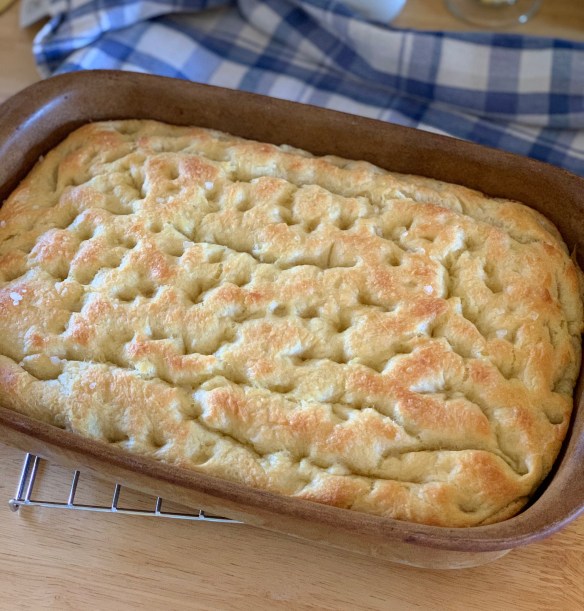
You are going to love this … soft, chewy, and the best focaccia you could possible imagine.  Can’t you just smell it from the photo?  Yum.

  • 2 1/2 tsp active dry yeast (or 1 pack)
  • 2 tsp honey
  • 2 1/2 cups lukewarm water
  • 1 tbsp kosher salt
  • 5 cups all purpose flour
  • 6 tbsp extra virgin olive oil – divided
  • 4 tbsp butter
  • flaky sea salt
  • 2-4 garlic cloves

Whisk 1¼-oz. envelope active dry yeast (about 2¼ tsp.), 2 tsp. honey, and 2½ cups lukewarm water in a medium bowl and let sit 5 minutes (it should foam or at least get creamy; if it doesn’t your yeast is dead and you should start again—check the expiration date!).

Add 5 cups (625 g) all-purpose flour and 1 Tbsp. kosher salt and mix with a rubber spatula until a shaggy dough forms and no dry streaks remain.

Pour 4 Tbsp. extra-virgin olive oil into a big bowl that will fit in your refrigerator. This puppy is going to rise! Transfer dough to bowl and turn to coat in oil. Cover with a silicone lid or plastic wrap and chill until dough is doubled in size (it should look very bubbly and alive), at least 8 hours and up to 1 day. If you’re in a rush, you can also let it rise at room temperature until doubled in size, 3–4 hours.

Generously butter a 13×9″ baking pan, for thicker focaccia that’s perfect for sandwiches, or an 18×13″ rimmed baking sheet, for focaccia that’s thinner, crispier, and great for snacking. The butter may seem superfluous, but it’ll ensure that your focaccia doesn’t stick. Pour 1 Tbsp. extra-virgin olive oil into center of pan. Keeping the dough in the bowl and using a fork in each hand, gather up edges of dough farthest from you and lift up and over into center of bowl. Give the bowl a quarter turn and repeat process. Do this 2 more times; you want to deflate dough while you form it into a rough ball.

Transfer dough to prepared pan. Pour any oil left in bowl over and turn dough to coat it in oil. Let rise, uncovered, in a dry, warm spot (like near a radiator or on top of the fridge or a preheating oven) until doubled in size, at least 1½ hours and up to 4 hours.

Place a rack in middle of oven; preheat to 450°. To see if the dough is ready, poke it with your finger. It should spring back slowly, leaving a small visible indentation. If it springs back quickly, the dough isn’t ready. (If at this point the dough is ready to bake but you aren’t, you can chill it up to 1 hour.) Lightly oil your hands. If using a rimmed baking sheet, gently stretch out dough to fill (you probably won’t need to do this if using a baking pan). Dimple focaccia all over with your fingers, like you’re aggressively playing the piano, creating very deep depressions in the dough (reach your fingers all the way to the bottom of the pan). Drizzle with remaining 1 Tbsp. extra-virgin olive oil and sprinkle with flaky sea salt. Bake focaccia until puffed and golden brown all over, 20–30 minutes.

No Knead Focaccia 3

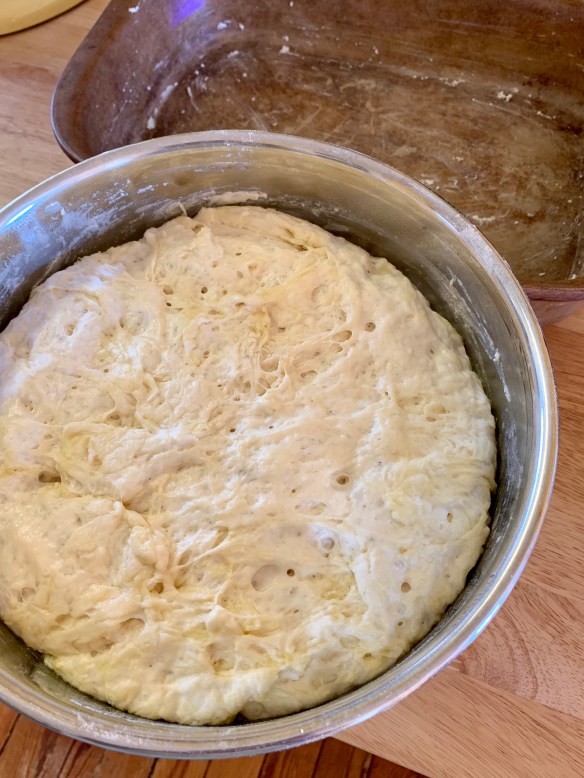
Rising with bits of oil throughout, this little fella has filled the bowl!

No Knead Focaccia 4

It’s pretty darn cold outside today, but this is sitting with the sun streaming in the window and the radiator near …. it rose beautifully.

No Knead Focaccia 1

Just look, 2 hours later it is fluffy and puffed right to the brim.

No Knead Focaccia 5

This is the part where you could get as interesting as you like …. add olives, or rosemary, or little tomato slices ….

I stopped before this last step, just because I wasn’t sure the 12, 9 & 6 year olds at the table wanted the garlic …. but next time!!!

Hold off on this last step until you’re ready to serve the focaccia: Melt 4 Tbsp. unsalted butter in a small saucepan over medium heat. Remove from heat. Peel and grate in 2–4 garlic cloves with a Microplane (use 2 cloves if you’re garlic-shy or up to 4 if you love it). Return to medium heat and cook, stirring often, until garlic is just lightly toasted, 30–45 seconds. (Or, if you prefer raw garlic to toasted garlic, you can grate the garlic into the hot butter, off heat, then brush right away.)

Brush garlic-butter all over focaccia and slice into squares or rectangles.

Focaccia Art 1

Too much time on my hands …. the Covid- 19 Coronavirus has us all hunkered down in our homes …. look what happens when you can’t go anywhere …

Focaccia Art 2

I was afraid how things would look after baking, but it’s pretty good!

I’ve reposted this from Bon Appetit “Basically” as part of their baking series, it is amazing!!!


Moist Delicious Corn Bread

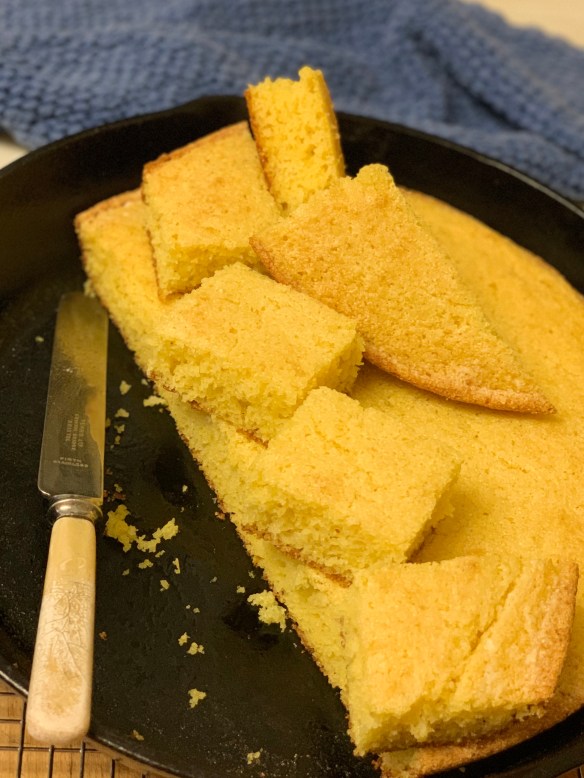
corn bread 2

Easily the quickest of quick breads, moist and tender …. this is absolutely delicious and one you must try.  Just another fantastic use for your cast iron skillet.  Serve this alongside some hearty chili or stew and you’ll have such a comforting meal.

  • 1 1/4 cups cornmeal
  • 3/4 cup all purpose unbleached flour
  • 1/4 cup sugar
  • 1 tbsp baking powder
  • 1 tsp baking soda
  • 1/4 tsp salt
  • 1 1/3 cups buttermilk
  • 2 large eggs, lightly beaten
  • 8 tbsp unsalted butter, melted
  1. Preheat oven to 425 and place a 12 inch cast iron skillet in to heat up while you make the batter.
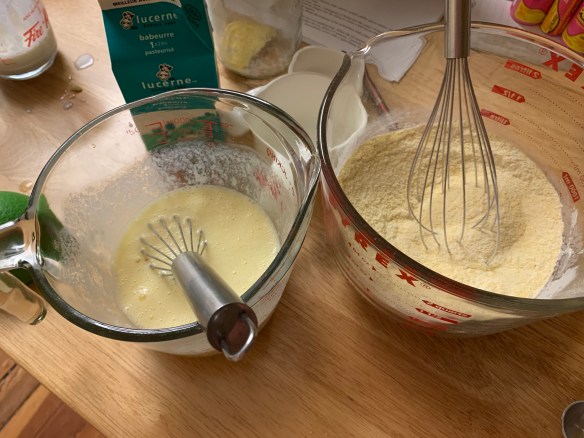
  2. In a large bowl whisk together the dry ingredients.  In a separate bowl whisk up the buttermilk, eggs, and 7 tbsp of the melted butter.
  3. Reduce the oven temperature to 375 and remove the skillet.  CAREFULLY … remember it is hot.
  4. Coat the skillet with the remaining tbsp of melted butter.  Pour the batter in the skillet and place it in the oven.  Amazing to watch …. it right away starts to puff up around the edges.
  5. Bake for 20-25 minutes until firm, and a tester comes out clean.  Let cool for 15 minutes before serving.
corn bread 3

This comes together so quickly – whisk up dry and wet ingredients separately and then quickly combine them.  Stir until you don’t see any lumps, but don’t over mix the batter.

Corn bread 4

As soon as the batter hits the hot pan it starts to smell amazing and I loved the way it puffed up around the edges of the cast iron.

Corn bread 1

It might be difficult, but let it sit for 15 minutes after removing from the oven.  Still warm enough to melt butter but holds together like a dream ….. try it, and I bet you love it.

Have you checked out http://www.jocooks.com ??  I got this recipe from her blog and it is most assuredly the best cornbread I’ve tried.  In fact, I think every recipe I try of hers I love!
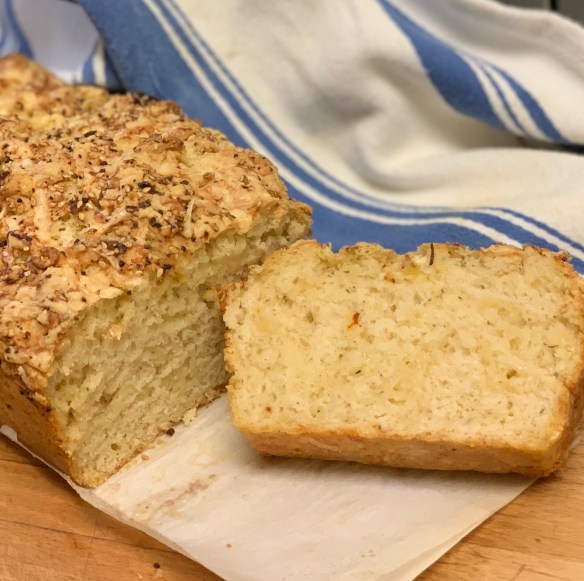
Beer Bread

Beer Bread 1

Today I created an extra crunchy crust …… first the melted butter, then sprinkled on some grated aged cheddar, and topped with the seasoned sesame seed mixture left from the dregs of the nuts and bolts mixture I made this Christmas – Y U M

This is the easiest, simplest quick bread!  The most difficult part of making this bread is waiting for it to come out of the oven while amazing smells are drifting through the house …..

  • 3 cups all purpose flour
  • 3 tsp baking powder
  • 1 tsp salt
  • 1/4 cup sugar
  • 1 can or bottle of beer
  • 1/4 cup melted butter

Preheat oven to 375 degrees.

Sift dry ingredients together and stir in 1 12 ounce bottle or can of beer – stir just until it all comes together and turn into a greased 9 x 5 inch loaf pan.  (I like to line the pan with parchment paper – it makes it so easy to lift out of the loaf pan.).

Drizzle the melted butter over and bake.

Bake for 1 hour until a tester comes out clean.

Rest for 10 minutes before removing from loaf pan, then let sit for at least 15 minutes before cutting.

Beer Bread 2

Aged white cheddar and Italian seasoning added today.


You can mix this up however you like – add in herbs, grated cheese or some seeds.

My cousin Vivian used dried dill weed in the flour mix, and put olive oil on top … try it!

I’ve had people ask if you can use soda instead of beer ….. not unless you add 2 tsp (or 1 packet) of instant yeast.  It is the beer that helps the bread to rise and not be a heavy lump of dough!

Did you know that you should sift your flour, and SCOOP (using a spoon) into your measuring cup instead of scooping with your measuring cup?  This helps make your flour lighter and in turn, your bread lighter.